
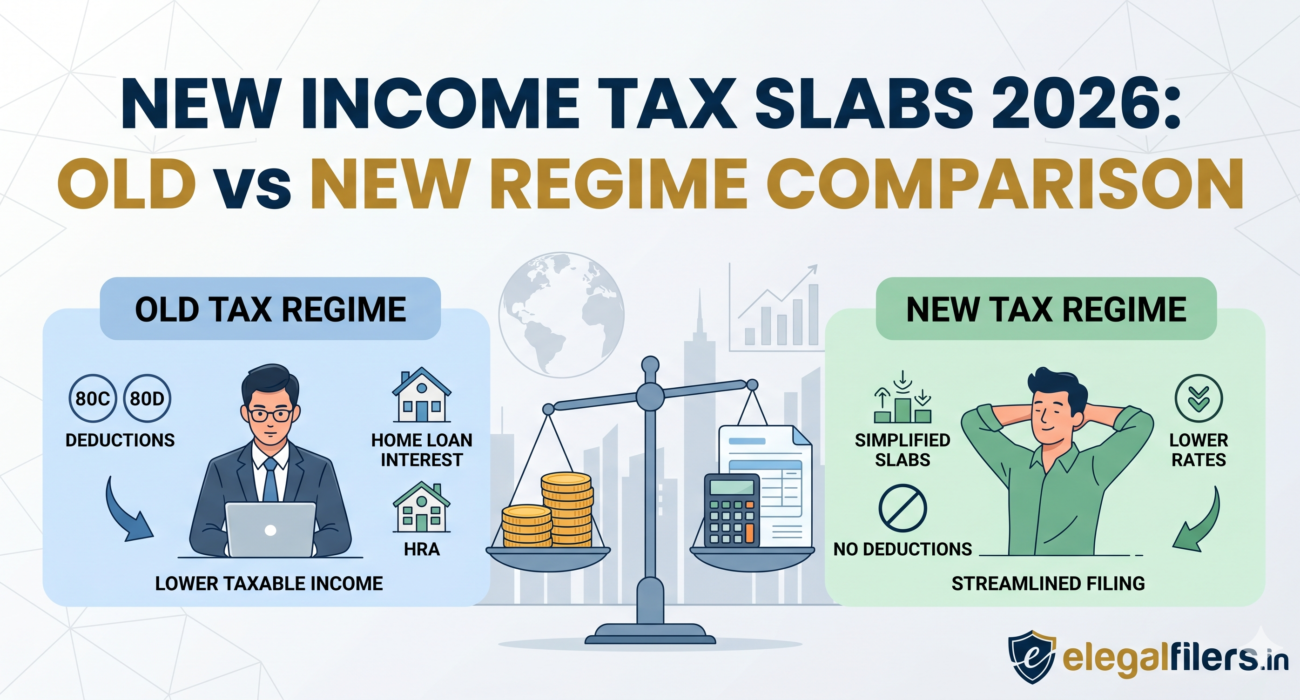
The Indian taxation landscape is undergoing a significant transformation with New Income Tax Slabs . As we move into Financial Year (FY) 2026-27 (Assessment Year 2027-28), the government has further solidified its push toward a simplified tax structure. Most notably, the Income Tax Act, 2025 officially takes effect on April 1, 2026, replacing the decades-old 1961 Act.
For the users of elegalfilers.in, understanding these changes is crucial for effective tax planning. Below is a comprehensive guide comparing the Old and New Income Tax Slabs for 2026.
1. The New Tax Regime (FY 2026-27)
The New Tax Regime remains the default option. It features wider tax slabs and lower rates but requires taxpayers to forego most deductions (like 80C, 80D, and HRA).
Following the updates in recent budgets, the slabs for FY 2026-27 are structured to provide maximum relief to the middle class:
| Income Slab (₹) | Tax Rate |
| Up to 4,00,000 | Nil |
| 4,00,001 to 8,00,000 | 5% |
| 8,00,001 to 12,00,000 | 10% |
| 12,00,001 to 16,00,000 | 15% |
| 16,00,001 to 20,00,000 | 20% |
| 20,00,001 to 24,00,000 | 25% |
| Above 24,00,000 | 30% |
Key Benefit: Thanks to the enhanced Section 87A rebate, individuals with a taxable income up to ₹12 lakh pay Zero Tax under the New Regime. For salaried employees, adding the ₹75,000 Standard Deduction means an effective tax-free income of up to ₹12.75 lakh.
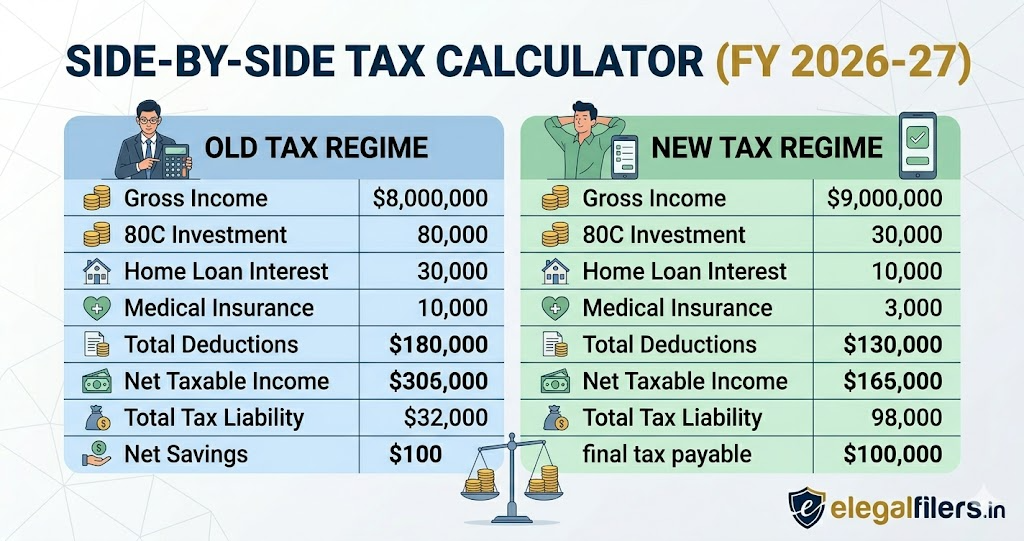
2. The Old Tax Regime (FY 2026-27)
The Old Tax Regime continues to be available for those who prefer to lower their taxable income through investments and expenses. While the rates are higher, the ability to claim deductions often makes it better for high-savers.
| Income Slab (₹) | Tax Rate (Individuals < 60 Years) |
| Up to 2,50,000 | Nil |
| 2,50,001 to 5,00,000 | 5% |
| 5,00,001 to 10,00,000 | 20% |
| Above 10,00,000 | 30% |
- Standard Deduction: ₹50,000 (Salaried individuals).
- Rebate u/s 87A: Available for income up to ₹5 lakh (Max rebate ₹12,500).
3. Key Differences at a Glance- New Income Tax Slabs
| Feature | New Tax Regime (Default) | Old Tax Regime (Optional) |
| Basic Exemption | ₹4,00,000 | ₹2,50,000 |
| Standard Deduction | ₹75,000 | ₹50,000 |
| 80C (LIC, PPF, etc.) | Not Allowed | Allowed (up to ₹1.5L) |
| 80D (Health Insurance) | Not Allowed | Allowed |
| HRA Exemption | Not Allowed | Allowed |
| Home Loan Interest | Not Allowed (Self-occupied) | Allowed (up to ₹2L) |
| Zero Tax Limit | Up to ₹12.75 Lakh (Salaried) | Up to ₹5.5 Lakh (Salaried) |
4. Major Changes in the Income Tax Act, 2025
Starting April 2026, several procedural changes come into play:
- Renamed Forms: Traditional forms are being replaced. For instance, Form 16 is now Form 130, and Form 26AS has been revamped as Form 168.
- Extended HRA Benefits: The 50% HRA exemption (previously limited to 4 metros) now includes Bengaluru, Pune, Hyderabad, and Ahmedabad.
- TCS Simplification: A flat 2% TCS now applies to overseas tour packages and LRS remittances for education/medical purposes, replacing the previous complex multi-rate structure.
5. Which Regime Should You Choose- New Income Tax Slabs?
The “best” regime depends entirely on your financial habits:
- Choose New Tax Regime if: You do not have many investments, live in a self-owned house, or earn between ₹10 lakh and ₹15 lakh without massive 80C/80D deductions.
- Choose Old Regime if: You pay a high home loan EMI, stay in a rented house with high HRA, and aggressively invest in tax-saving instruments exceeding ₹2.5 – ₹3 lakh in total deductions.
Final Word for New Income Tax Slabs
With the implementation of the Income Tax Act, 2025, the government is making a clear move toward a “no-deduction, low-rate” system. While the New Regime is becoming more attractive every year, the Old Regime remains a powerful tool for those with significant financial commitments.
For personalized tax planning and filing, stay tuned to elegalfilers.in — your partner in seamless legal and financial compliance!
Comment Your Thoughts Below so we can get more point of view.