

The GST Registration Process in India: A Comprehensive 2026 Guide has redefined the Indian economy by consolidating multiple indirect taxes into a single, streamlined system. As of April 2026, with the full implementation of the Income Tax Act, 2025 and updated GST compliance rules, the registration process has become more digital, secure, and business-friendly.
Whether you are a budding entrepreneur or an established business owner, this guide provides everything you need to know about GST registration in India.
1. Who Needs GST Registration? (Threshold Limits 2026)
Before applying, it is essential to know if your business falls under the mandatory registration criteria. For FY 2026-27, the following threshold limits apply:
- Suppliers of Goods: Mandatory if aggregate annual turnover exceeds ₹40 lakh (₹20 lakh for Special Category States like Manipur, Mizoram, etc.).
- Service Providers: Mandatory if aggregate annual turnover exceeds ₹20 lakh (₹10 lakh for Special Category States).
- Inter-State Suppliers: Registration is mandatory if you supply goods or services across state borders, regardless of turnover.
- E-commerce Sellers: If you sell through platforms like Amazon, Flipkart, or Meesho, you must have a GSTIN from day one.
- Casual/Non-Resident Taxable Persons: Individuals occasionally supplying goods/services in India must register at least 5 days before starting business.
2. Documents Required for GST Registration Process in India
Keeping your documents ready is the key to a rejection-free application. The requirements vary based on the type of business:
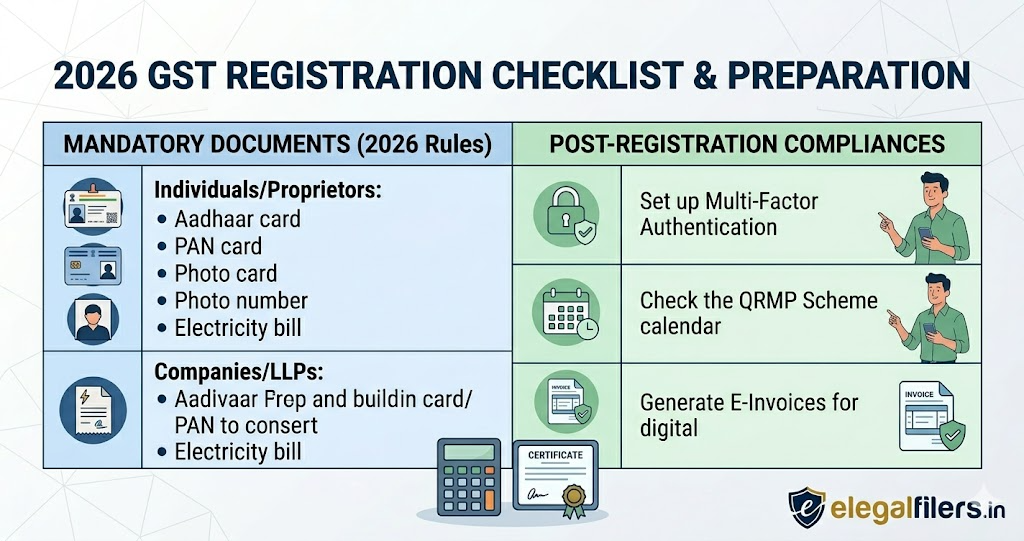
GST Registration Process – For Individuals & Proprietorships:
- PAN Card and Aadhaar Card of the owner.
- Photograph of the owner.
- Proof of Business Address: Electricity bill, property tax receipt, or a valid Rent Agreement along with an NOC from the owner.
- Bank Account Proof: Cancelled cheque or bank statement showing the account holder’s name and IFSC.
GST Registration Process – For Companies (Private/Public) & LLPs:
- PAN Card of the Company/LLP.
- Certificate of Incorporation (COI).
- MoA & AoA (for Companies) or LLP Agreement.
- PAN and Aadhaar of all Directors/Partners.
- Board Resolution appointing the Authorized Signatory.
- Digital Signature Certificate (DSC): Mandatory for companies and LLPs to sign the application.
3. Step-by-Step GST Registration Process
The entire process is managed via the GST Common Portal.
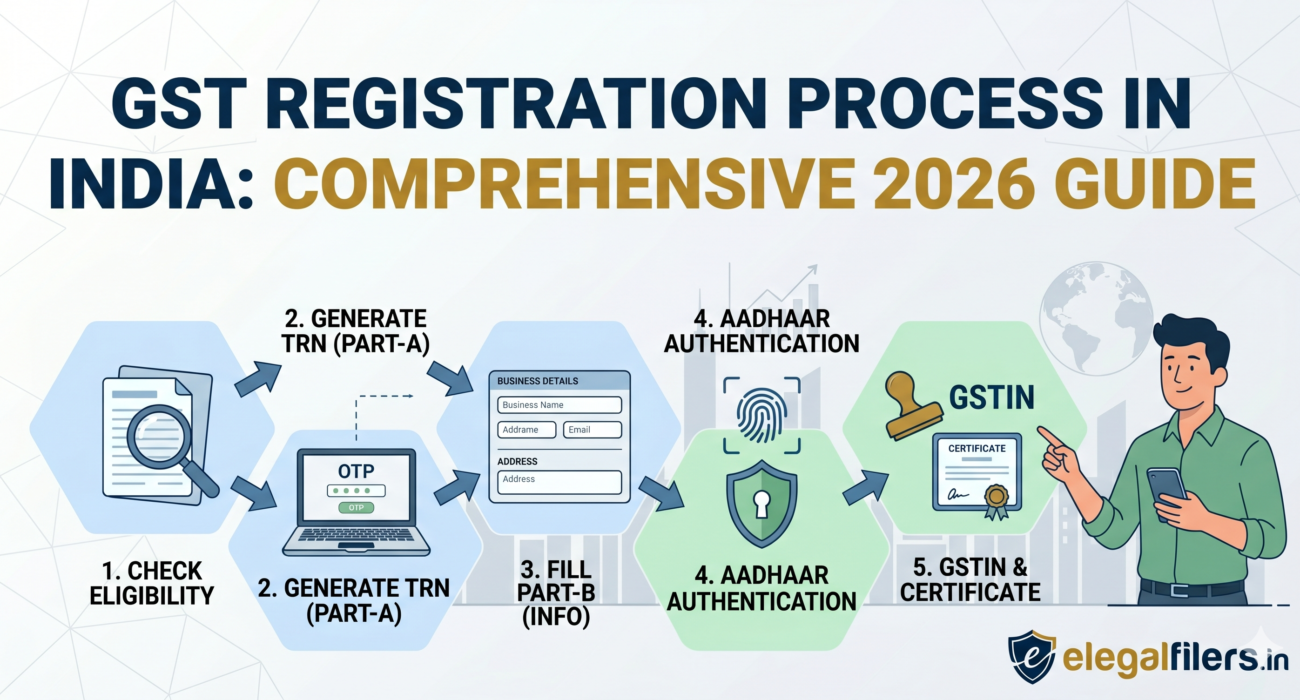
Step 1: Generate TRN (Part-A)
- Go to the GST Portal > Services > Registration > New Registration.
- Select “Taxpayer” and enter your State, District, Legal Name (as per PAN), and PAN number.
- Enter your Email and Mobile number. You will receive two different OTPs.
- Once verified, a Temporary Reference Number (TRN) is generated and sent to you.
Step 2: Fill Part-B of the Application
- Log in using your TRN and the OTP sent to your mobile.
- Complete the 10 sections of the application, including:
- Business Details: Constitution of business and commencement date.
- Promoter/Partner Details: Personal info and photos.
- Principal Place of Business: Upload address proof documents.
- Goods & Services: Search and add relevant HSN codes (for goods) or SAC codes (for services).
- Aadhaar Authentication: Opt for Aadhaar authentication for faster approval (usually within 3–5 days).
Step 3: Verification & Submission for GST Registration Process
- Review all details in the “Verification” tab.
- Sign the application using EVC (OTP-based for individuals) or DSC (for companies).
- Upon submission, you will receive an Application Reference Number (ARN) via email.
4. What Happens After Submission?
Once you have your ARN, the GST officer reviews your application:
- Approval: If the documents are in order, the GSTIN and Registration Certificate (Form GST REG-06) are issued within 7 working days.
- Clarification (Notice): If the officer finds discrepancies, they issue a notice in Form GST REG-03. You must respond within 7 working days in Form GST REG-04.
- Rejection: If the response is unsatisfactory, the application is rejected via Form GST REG-05.
5. Benefits of Registering for GST
While compliance is often seen as a burden, GST registration offers significant business advantages:
- Input Tax Credit (ITC): You can claim credit for the tax paid on your purchases (raw materials, rent, office equipment), effectively reducing your tax liability.
- Legal Recognition: It establishes you as a legally recognized supplier of goods or services.
- Inter-State Expansion: You can legally sell your products across India without restrictions.
- B2B Credibility: Large corporations and government agencies prefer working with GST-registered vendors to ensure they can claim ITC.
6. Post-Registration Compliances (2026 Rules)
Obtaining your GSTIN is just the beginning. To stay compliant in 2026, keep these new rules in mind:
- Multi-Factor Authentication (MFA): Since April 2025, MFA is mandatory for all portal logins to enhance security.
- QRMP Scheme: Small businesses with a turnover up to ₹5 crore can opt for the “Quarterly Return, Monthly Payment” scheme to reduce the filing burden.
- E-Invoicing: If your turnover exceeds ₹10 crore, you must generate e-invoices within a 30-day window of the invoice date.
- Standard Deduction & Filing: Ensure your returns (GSTR-1, GSTR-3B) are filed within the 3-year statutory time bar now enforced by the portal.
7. Common Mistakes to Avoid
- PAN Name Mismatch: Ensure the “Legal Name of Business” matches your PAN card exactly. Even a small spelling error leads to rejection.
- Blurry Documents: Always upload high-quality scanned PDFs or JPEGs (under 100KB for photos).
- Incorrect HSN Codes: Using the wrong HSN/SAC code can lead to tax rate disputes later.
- Address Mismatch: The address on the electricity bill must match the address entered in the form.
Conclusion – GST Registration Process in India
The GST registration process in 2026 is faster and more transparent than ever before. For small businesses, it is not just a legal requirement but a strategic tool for growth, enabling access to national markets and tax savings through ITC.
If you find the process overwhelming or need help with complex documentation for Companies or LLPs, elegalfilers.in is here to assist. Our experts ensure your GST application is filed correctly the first time, saving you from notices and delays.
Get your business GST-ready today! Visit elegalfilers.in for expert assistance.